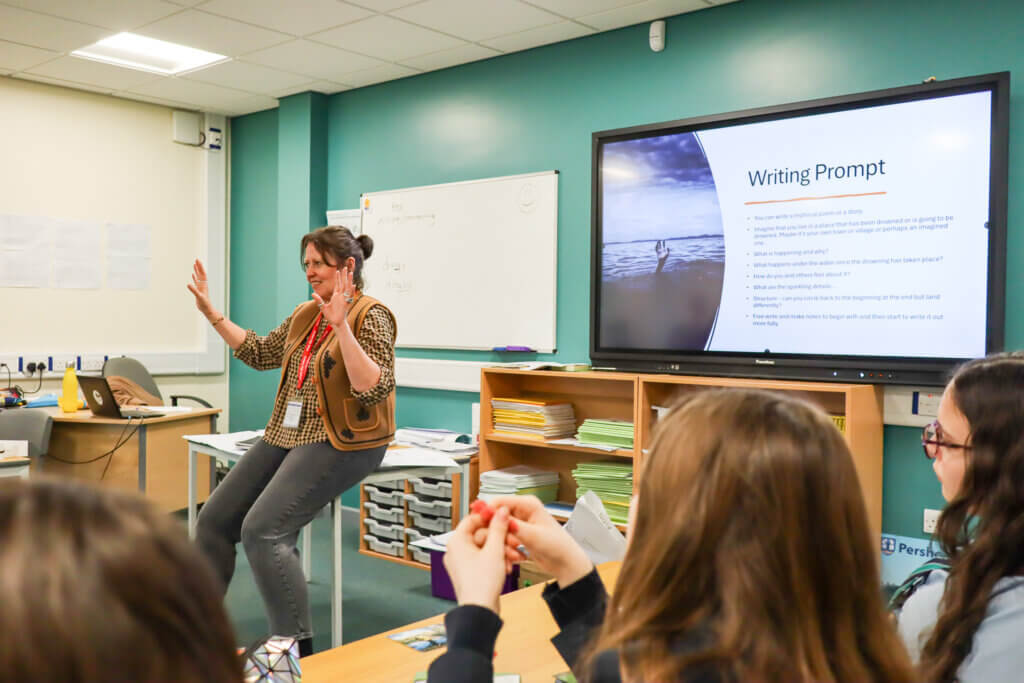
The project was developed in response to a student wellbeing survey that Pershore High school conducted. The survey demonstrated the need for a project that supported the mental health and wellbeing of their students, enabling them to express their thoughts and feelings using visual arts and creative writing, especially when exploring emotive topics such as climate change. The school were also interested in addressing a “lack of cultural capital” within the school population, with pupils having limited access to cultural activities and opportunities.
In addition, the project provided Meadow Arts with the opportunity to address one of their organisational challenges, through the development of a practical resource to support young people’s engagement across any of their exhibition programmes, in any of their varied locations. As a contemporary visual arts organisation with no venue, Meadow Arts exhibits artworks in unusual places, often in rural settings across Herefordshire, Worcestershire, and Shropshire.
What happened?
Meadow Arts worked with Pershore High to pilot a practical process for cross-curricular and cross-departmental practice between the Art and English departments. They worked with a mixed group of students from school years 8-10, many of whom were confident in their writing skills, taking part in an extra-curricular creative club, but less confident or engaged with visual arts.
JLM Morton was selected as the writer on the project due to her own practice as a poet and non-fiction writer, which is rooted in her connection to water, rural language and spaces.
Students visited the artwork ‘Deluge’ by Hilary Jack, a piece commissioned by Meadow Arts, on display at Pershore Abbey. The large-scale artwork explores climate change and flooding using found text from global news reports on floods and mythological narratives, presenting them on parallel, scrolling LED panels, similar to a tv news report.
The students were encouraged to explore the space and concepts, and question how interpretations of the work could be affected by the context it was shown in (a religious space). They collected found words, took photographs and made notes on their thoughts and responses, to be used as a source of inspiration for creative writing. Students also visited the flood plain meadows alongside the river Avon to explore a hyper-local real-world example of flooding in their own community, and made creative writing responses to their experiences in the moment.
JLM Morton led a series of creative writing workshops in school using a variety of writing techniques and provocations. Students responded strongly to the themes of climate change and flooding in their local area. Almost all students identified climate change as an important and worrying issue to them and they appreciated the chance to explore this is in a safe environment. The opportunity to open a dialogue with others and express their thoughts creatively supported their wellbeing through the identification of shared concerns about this topic.
Through the project, Alex Hodson the English teacher, and Head of Art David Reid, created an extensive visual art curriculum using the work of Hilary Jack as a starting point. David supported the students to use their written work and take it through a series of visual art processes in order to create their own text based visual art works inspired by the work that they had seen.
Learning
Students developed their skills and confidence through the project. They learned new ways to explore art work in unusual places and to find creative ways to do research in preparation for writing. Concrete skills and new techniques were learned in both art and creative writing e.g. learning to do cyanotype, increased conceptual literacy, and exploring new ways to write and approach the subject of climate change. Some of the most effective activities were felt to be in response to poetry themed around the same concerns as Deluge by Hilary Jack. The work that the students produced as a result of being involved in the project was seen as being excellent and a rich mix of programming was provided.
The project created a space for students to discuss their understanding and concerns around climate change. The levels of anxiety amongst students in response to this topic was surprising to all partners. Care was an important element in the project, particularly in creating and holding a safe space for pupils to explore their feelings. As a result pupils were very open in discussing how they felt. As well as addressing issues through creative activities and discussions, students were provided with practical support and advice on how they could support one another, take local action to address climate change and were given examples of the methods that writers and artists employ to use their voices to influence others. The school intend to do more work on supporting pupil wellbeing in relation to climate change in future.
‘I enjoyed what we did today. Although I am more of a writer I really liked the activity and I’m quite proud of how my slide came out. I’ve really enjoyed the experience. It is very different from normal school but I’ve learned a lot.’
‘I have enjoyed expressing my opinions and imagination through art AND creative writing. It has also been interesting to explore other people’s pieces and becoming inspired by them. It has been a new experience for me and I have found it incredibly interesting. ‘
– Student participants
New partnerships were created through the project, and there are already plans to continue this collaboration in future. The project delivery was seen as being more challenging than originally anticipated due to the complexities of working across two departments in a secondary school. Timetabling when working across different year groups was also complex to navigate at times. As a result, there was less cross-curriculum working than originally planned, however the project was viewed as a very useful pilot with many learning points to take forward into refining cross-curriculum programming at the school. The staff were inspired by this way of working and by having multiple voices and viewpoints involved in the project.
‘The one key thing that stuck with me was when some of the students commented on how learning outside of the classroom seemed to promote deeper thinking and a sense of individual growth. The routine of school can dull the senses and that the weekly writing with Alex and the new experiences this project has introduced has made learning richer and more empowering. They felt encouraged to be themselves’
– Teacher