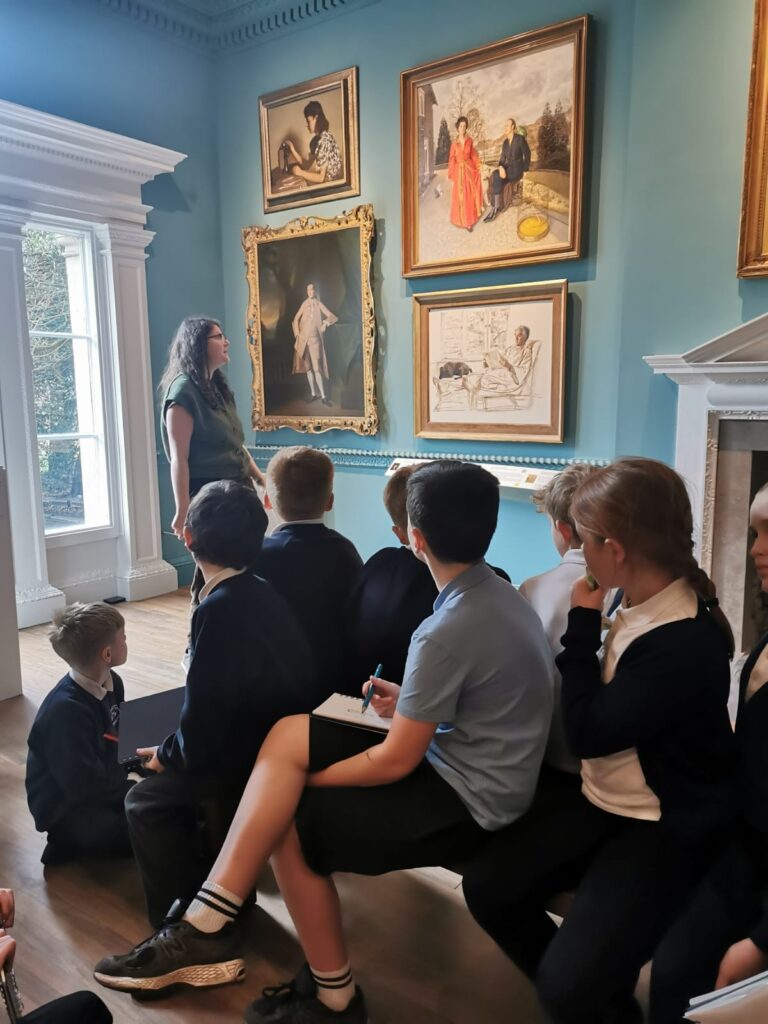
Local schools in Kendal can find it difficult to access Abbot Hall Art Gallery regularly. With a collection that has strong connections to local history and the people of Cumbria, the Lakeland Arts team identified an opportunity to develop a closer relationship between the gallery and local schools.
There was also a question about young people’s relationship with Cumbrian dialect. Previous workshops with school children had shown that this relationship could be fragmented. Some young people used dialect words every day without recognising them as dialect, while others had little or no knowledge that Cumbria had its own regional language.
The project set out to explore whether the gallery’s portrait collection could provide a starting point for conversations about Cumbrian identity, and whether dialect could become a playful and creative tool for young people to explore language, belonging and place.
Approach
Working with writer Katie Hale, the project was structured around three main phases, gradually moving from looking, to writing, to exploring dialect and identity.
The first phase introduced pupils to the gallery environment. Through sketching and observation activities, they were encouraged to explore paintings in their own way. The team observed which artworks the pupils were drawn to and used these responses as inspiration for the creative writing that followed.
The second phase introduced creative writing techniques, using the paintings as prompts. Pupils created acrostic poems from things they could see in the paintings before writing poems about themselves. They were encouraged to describe permanent aspects of their identity and to think carefully about how they might represent their homes and personalities. Creative writing activities helped them develop more imaginative descriptions of themselves and places around them.
A key part of the approach was providing a strong framework for pupils who might otherwise be reluctant to write. Short activities and worksheets gave them ideas to work from, often without initially presenting the activity as ‘writing a poem’. For example, a quick-fire bingo activity asked pupils questions such as what their favourite smell was or what they could see from their bedroom window. This then became material for poetry. By breaking the process into manageable steps, pupils were able to generate ideas without feeling that they had to start a poem from a blank page.
The third phase introduced Cumbrian dialect. This prompted lively discussions about whether dialect words could sometimes describe something in a better way than standard English, and whether there is still a place for Cumbrian dialect in the modern world. The pupils’ responses revealed a surprisingly varied relationship with dialect. Some used it regularly, particularly those with farming and family connections to the local area. Others used dialect words without realising, while some had never heard of Cumbrian dialect at all. One pupil realised that words they had previously thought their grandparent had simply ‘made up’ were actually words particular to their local area. A word bank was developed from the words pupils knew and used.
The final stage brought the different strands of the project together. Pupils combined their poems about themselves with poems responding to the portraits to create either ekphrastic or conversation poems. The central idea was to imagine that the person in the painting could step out of the frame and speak. How would a young person today describe themselves to them and how might they describe the person from the past? The resulting poems created conversations between modern day young Cumbrians and people from Cumbria’s past.
Learning and Impact
The project supported pupils who often found reading and writing difficult, or were reluctant to engage with creative writing. By providing a clear framework and breaking the writing process into a series of small, manageable activities, all 90 pupils produced at least one poem responding to Abbot Hall Art Gallery’s portrait collection. Short games, prompts and writing exercises helped generate ideas without the pressure of having to write a poem from a blank page. As the sessions progressed, pupils became more willing to experiment with language and increasingly saw themselves as writers.
The project also created opportunities for pupils to develop their confidence in speaking and sharing their work. At the beginning, many pupils were reluctant to speak in front of others or share their ideas. Over time, some became increasingly comfortable contributing to discussions and reading their work aloud. One pupil in particular was initially very quiet and reluctant to engage. During one activity, he wrote a particularly vivid description: “It glistened like a leaf at the end of a branch on a sunny day.” When his writing was praised, he later chose to share it with the group. This was something he had not done previously, and the positive response from the other pupils gave him a visible sense of achievement.
The project also helped pupils develop a stronger sense of the gallery as a place where they could belong and contribute. They began the project unfamiliar with how to behave and participate in a gallery environment, but by the end they were comfortable navigating the space and engaging with the collection.
The introduction of Cumbrian dialect added a playful dimension to the writing. For some pupils, using words that they did not associate with formal English lessons helped remove some of the seriousness they attached to writing. Exploring Cumbrian dialect also gave pupils another way to think about their relationship with place and identity. By the end, pupils had a greater understanding that some of the words used in their communities were particular to Cumbria and not used elsewhere.
Reflections from the Project Team
One of the key areas of learning was the value of a considered workshop structure and how a sequence of small activities can help remove the barriers associated with literacy. For example the use of conversation poetry encouraged close looking, while giving pupils a clear reason to write. This approach helped challenge the pupils’ preconceptions about creative writing, gave them confidence and made the process feel achievable. The team also learnt about the potential of local dialect as a tool for exploring place and identity. The range of relationships pupils had with Cumbrian dialect was not anticipated and became an important discovery during the project.
The project provided valuable learning around the practicalities of delivering creative activity within a gallery setting. Working with 90 pupils across three classes required significant coordination between the gallery and school. The team also recognised the importance of allowing pupils time to transition from the school environment into the gallery and into a creative mindset. They reflected that in future projects, longer sessions would provide more time for this transition and allow pupils to settle into the space before beginning the main creative activities.
“We had a few communication difficulties right at the start when we were first figuring out logistics and time frames, but eventually the visits ran like clockwork.” Annie Brewer, Lakeland Arts