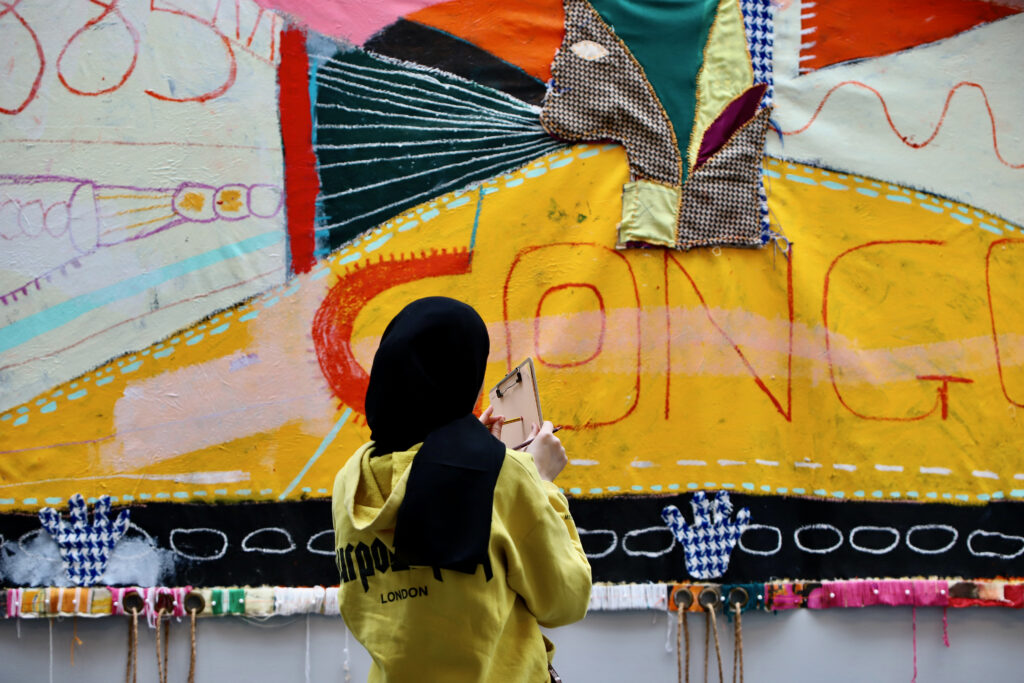
‘A word to our city’ project built on an existing relationship with Nottingham Education Sanctuary Team (NEST). It also furthered Nottingham Contemporary’s long- standing commitment to work with refugee communities and support services. Almost 20% of Nottingham’s population were born outside of the UK (2011 Census) and it is estimated that this figure has risen further since 2015.
The project drew on the findings of the academic research project The Art of Belonging, 2022, which looked at the social integration of young refugees, through arts and culture place-making (for which NEST was the UK education partner). The MaxLiteracy Awards programme provided the opportunity to introduce a new approach to this work through the use of creative writing, multi-modal approaches and social discourses of writing, with the aim of developing a city-wide creative programme and engagement framework with young people who are refugees and asylum seekers.
The project partners specifically aimed to explore the following research questions together:
- How do we welcome and support young people to make a new home in our towns and cities?
- How do we develop so that young people feel they belong in our arts and cultural spaces?
- How can approaches shape our own practice and inclusion work?
Approach
NEST works with children and young people, many of whom are going through the asylum process, with all the trauma and challenges that are implicit within that experience. Students attend NEST for up to a year, whilst in foster care or other accommodation. Young people who attend NEST speak a variety of different languages and their spoken and written English language skills are often very limited.
Nottingham Contemporary and NEST identified the potential that the project had in developing students English, verbal and written skills. This is one of NEST’s core aims, in order to prepare students to achieve qualifications at Entry Levels in Functional Skills, Maths, ICT and English in the form of ESOL Skills for Life. The project responded to the students’ survival literacy needs- developing language through a multi-modal approach to engagement, with a variety of contemporary art exhibitions; by encouraging students to make their own art; and through the writing of poetry, character-based stories and graphic story telling.
Before project delivery began, writer Peter Rumney worked closely with Johnathan Cutting (Lead teacher at NEST) to carefully consider the factors that can affect students’ wellbeing to ensure that it was prioritised within decisions and planning. There were many factors to consider within the project to ensure all aspects of the content and delivery were mindful of the pupils involved and sensitive to their needs. For example, the project team ensured that they were always accepting and affirming of the use of home languages, and the blending home language with English, wherever this was helpful or empowering to the young people. To reinforce this, many key words and phrases were translated into multiple languages to ensure wider access and support for participants.
The planning and reflection on this process involved drawing on the expertise of Jonathan’s teaching practice with asylum seekers and refugees, as well as trauma informed training for the creative writer and the Nottingham Contemporary staff involved.
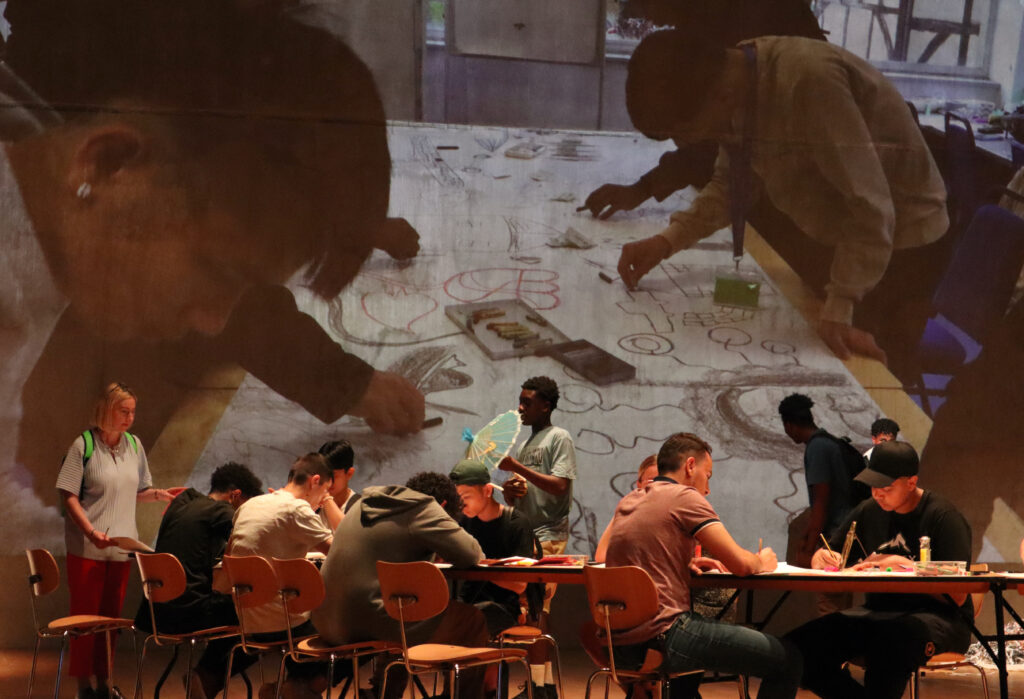
Programme delivery happened between Sept 2023-June 2024 at NEST and at partner cultural venues including Nottingham Castle, Lakeside Arts, Nottingham Contemporary and New Art Exchange. The project involved 4 cohorts of 15 – 20 pupils which each cohort taking part in a 6-session programme as part of their enhanced curriculum provision. Each programme was co-created with Jonathan Cutting (NEST) and Peter Rumney (Creative Writer), and delivered by both, in collaboration and individually. Each cohort of students experienced 5 sessions at NEST and 1 session at a cultural venue. Writer Peter Rumney delivered 1 or 2 sessions at NEST, as well as 1 session at a cultural venue for each cohort.
Whilst there were 4 separate cohorts of pupils, some pupils elected to join further cohorts too for some of the sessions, demonstrating the enjoyment and value that they placed on being part of the programme.
Reflection meetings after workshop delivery were seen as being essential to inform each step of the project. This also reinforced and developed Nottingham Contemporary’s commitment to qualitative and reflective approaches in their working.
“This programme developed to be more meaningful through our reflections about the requirements of the students that we worked with and the measurable impact that the programme could potentially offer.” – Lisa Jacques
Learning
Students
Student confidence increased over the course of the project in relation to both writing and speaking, as well as feeling comfortable to express their views as part of the group. This was evidenced through an evaluation tool in the form of a drawing frame which was repeated at the beginning and end of the sessions to encourage students to reflect on their learning. Over the course of the project students shared stories which touched on their personal experiences, which demonstrated that they felt safe in the space to share this in some way. The partners also highlighted ‘glow moments’ that were observed through the sessions, which provided insight into the students’ positive experiences of being part of the programme.
“There was one particular student who was a key young man within a cultural group. To begin with I think he was concerned with how he would deal with it- how he would appear to his peers. Over the course of the sessions he let go of a lot of this and although writing in English was a real struggle, it was clear that he built confidence to engage with the process. ” – Peter Rumney
Some students attended sessions as part of multiple cohorts and it was observed by the project partners that these students in particular demonstrated an improvement in their confidence due the repetition and familiarity of tasks. This in turn created an atmosphere in which they felt comfortable in the cultural spaces and with the writer and others involved in the project. This was demonstrated by students beginning tasks before being asked, as they had developed understanding of the expectations that were placed on them in the sessions and settings, and a change in their attitude from when they entered and left the session. As an example, students who attended multiple sessions would shake the hand of Peter and smile when they then came to subsequent sessions.
“One of my best moments from the project was the visit to Nottingham Castle. It was very close to the entrance to the school, but none of the students had been in there yet. We were looking at portraiture- past, present and future. This was not an easy concept to share with participants who don’t speak much English. However, when doing recall on the visit with them in another session, one student called out “past, present and future!”. This showed that the language was becoming embedded, and that person had the confidence to share it in the group. For me that also showed that the risk to take on big, complex concepts to explore through art in order to develop ‘survival language’ was working.” Peter Rumney
Partners
Amongst the many principles upon which the project was built, and which were tested and developed throughout, the partners in the project have highlighted the following learning points which will inform further work with NEST, as well as the wider umbrella of work with cultural partners in the city.
- Accepting that sharing and developing verbal language is more important than writing at this point in the students’ learning.
- Accepting and affirming the use of home languages, or blending home language with English, wherever helpful or empowering.
- Offering translations into home languages for key words or ideas.
- Scaffolding and modelling everything at every stage.
- The use of familiar tropes learned during previous sessions to develop further understanding, e.g. using portraiture ‘frames’ as seen on gallery in different ways, such as; drawing in frames, structuring narrative writing through visual frames, formatting accessible evaluation tools with frames
- Being prepared to explore ‘big concepts’ inspired by art works and cultural venues to enable the learning of ‘utilitarian language’, e.g. drawing on the sense of the past, present and future at Nottingham Castle to structure a story.
“It’s opened up new approaches and developed their confidence in writing and connection to the city.” Jonathan Cutting
- Fostering student centric learning, collaboration, and peer-mentoring.
- Using diverse imagery and intercultural references to engage the whole group, and to help make positive connections with the host culture.
- Being aware of personal or cultural sensitivities, and challenging life experiences when engaging with artworks.
“I was not in most of the sessions but attended one at Lakeside and got to meet pupils and chat with them. It really brought everything together, having conversations with them and supporting what they were doing. It reaffirmed why we needed to do this.” Lisa Jacques